Understanding Edge-of-Stability Training Dynamics with a Minimalist Example
* Equal contribution
Abstract
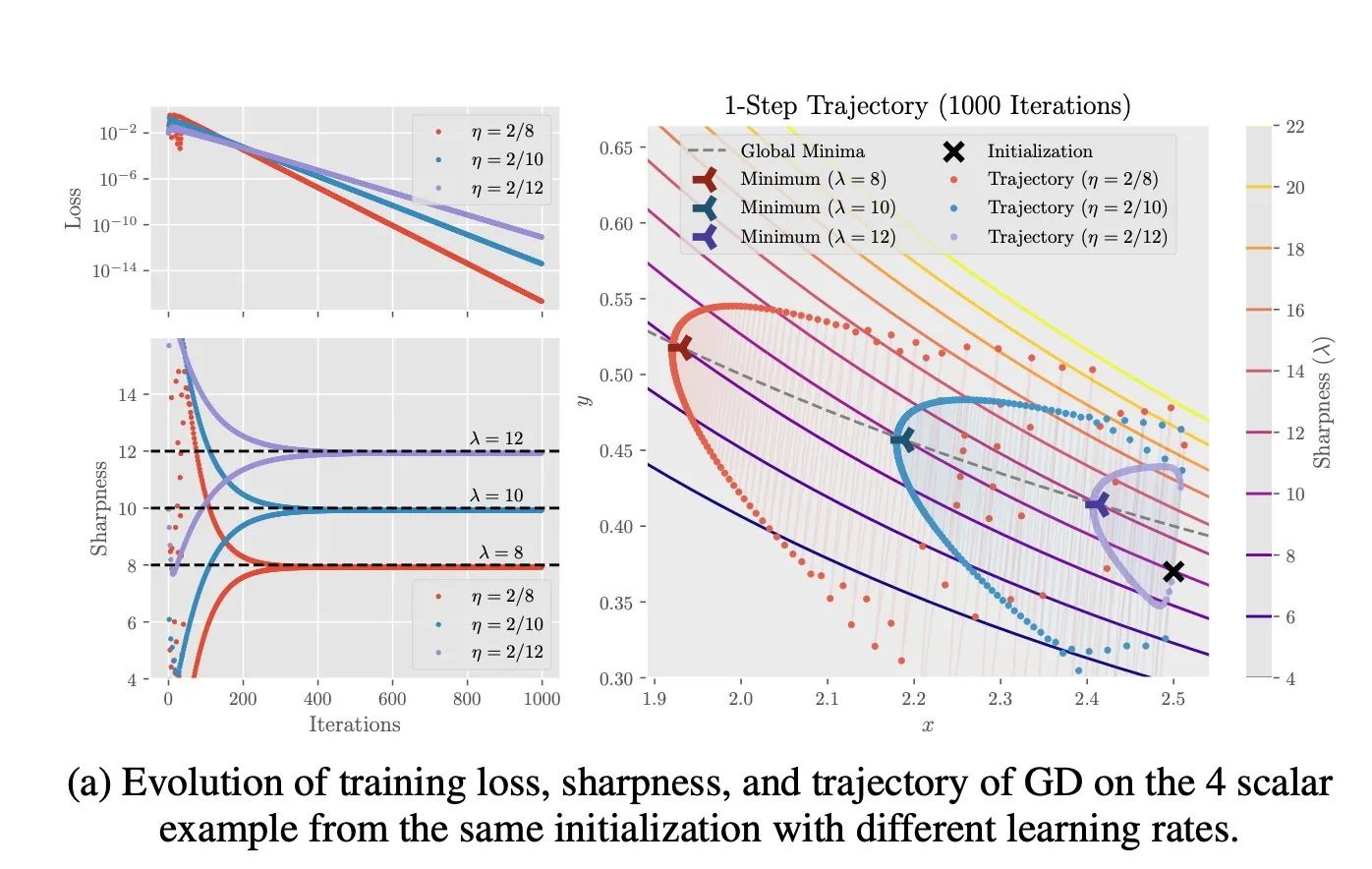
Recently, researchers observed that gradient descent for deep neural networks operates in an “edge-of-stability” (EoS) regime: the sharpness (maximum eigenvalue of the Hessian) is often larger than stability threshold (where is the step size). Despite this, the loss oscillates and converges in the long run, and the sharpness at the end is just slightly below . While many other well-understood nonconvex objectives such as matrix factorization or two-layer networks can also converge despite large sharpness, there is often a larger gap between sharpness of the endpoint and . In this paper, we study EoS phenomenon by constructing a simple function that has the same behavior. We give rigorous analysis for its training dynamics in a large local region and explain why the final converging point has sharpness close to . Globally we observe that the training dynamics for our example has an interesting bifurcating behavior, which was also observed in the training of neural nets.
Citation
@misc{zhu_understanding_2023,
  author    = {Zhu, Xingyu and Wang, Zixuan and Wang, Xiang and Zhou, Mo and Ge, Rong},
  month     = {February},
  publisher = {arXiv},
  title     = {Understanding Edge-of-Stability Training Dynamics with a Minimalist Example},
  url       = {http://arxiv.org/abs/2210.03294},
  year      = {2023}
}