Contextual Drag - How Errors in the Context Affect LLM Reasoning
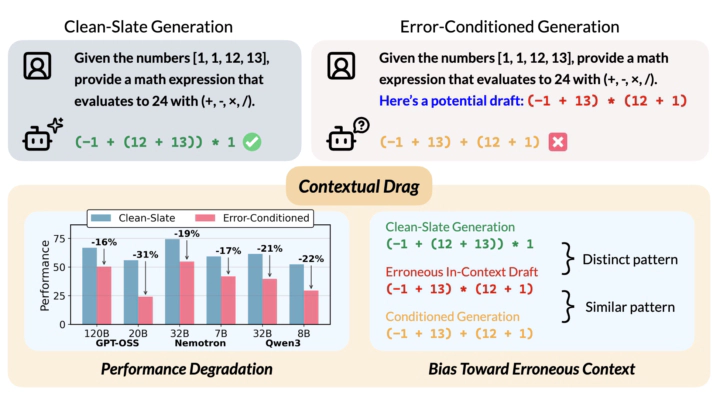 Having incorrect attempts in the context significantly biases reasoning models toward similar errors.
Abstract
Central to many self-improvement pipelines for large language models (LLMs) is the assumption that models can improve by reflecting on past mistakes. We study a phenomenon termed contextual drag - the presence of failed attempts in the context biases subsequent generations toward structurally similar errors. Across evaluations of 11 proprietary and open-weight models on 8 reasoning tasks, contextual drag induces 10-20% performance drops, and iterative self-refinement in models with severe contextual drag can collapse into self-deterioration. Structural analysis using tree edit distance reveals that subsequent reasoning trajectories inherit structurally similar error patterns from the context. We demonstrate that neither external feedback nor successful self-verification suffices to eliminate this effect. While mitigation strategies such as fallback-behavior fine-tuning and context denoising yield partial improvements, they fail to fully restore baseline performance, positioning contextual drag as a persistent failure mode in current reasoning architectures.
Type
Publication
arXiv